
The Ultimate Guide to Selecting a Candidate Search API for Your AI Recruiting Product

Updated: Jun 5
As AI recruiting platforms continue to evolve, the Candidate Search or Sourcing API has become a critical layer of product infrastructure. It’s no longer just about finding candidates, it’s about powering intelligent recruiting workflows with AI-driven search, matching, enrichment, and engagement capabilities.
Modern recruiting products are moving beyond traditional Boolean search. The next generation of AI recruiting platforms requires APIs that can understand recruiter intent, interpret job descriptions, recommend relevant candidates automatically, and power AI recruiting agents end-to-end.
If you’re building or scaling an AI recruiting product, choosing the right Candidate Sourcing API will directly impact your product release timeline, search quality, user experience, and long-term customer retention.
Here’s how to evaluate the right solution and what modern AI recruiting platforms should expect from their infrastructure.
1. Built for AI Recruiting Workflows
The best Candidate Sourcing APIs are purpose-built for recruiting workflows and AI-powered talent products.
Modern recruiting platforms require far more than keyword-based search. Today’s users expect intelligent workflows such as:
AI-powered candidate sourcing
Natural language candidate search
Job description-to-search conversion
AI candidate recommendations
Talent rediscovery from ATS/CRM databases
Candidate enrichment and engagement
Recruiting workflows require:
Source → Match → Evaluate → Outreach → Engage
A modern API should support the entire workflow, not just candidate retrieval.

What to Look For
Complete candidate profiles: full work history, education, skills, certifications, and specializations
Recruiter-ready contact data: personal emails and mobile numbers
AI-powered search and matching capabilities
Structured data optimized for AI agents and automation
Preview-before-unlock workflows for cost-efficient product UX
Why This Matters
Your users are no longer just recruiters — they may also be AI recruiting agents, copilots, matching systems, or automated sourcing workflows.
The API should provide intelligent, decision-ready data that enables automation and high-quality candidate recommendations at scale.
2. Intelligence in Candidate Search API
Search quality defines your recruiting product experience.
Most traditional sourcing systems still rely heavily on Boolean logic and keyword matching. While functional, these approaches often create rigid workflows, missed candidates, and poor recruiter experiences.
Modern AI-powered recruiting products require search systems that understand recruiter intent, semantic meaning, and role context.
Key Evaluation Criteria
AI-Powered Search Capabilities
With intelligent search abilities, recruiters should be able to:
Automatically expand similar job titles after entering the initial job title(s)
Describe an ideal candidate in plain language
Paste a full job description
Instead of manually building long Boolean strings and title lists.
Expanded Title Search
A strong API should intelligently expand related job titles automatically.
For example:
“Software Engineer” may also surface:
Backend Engineer
Software Developer
Full Stack Engineer
This helps recruiters and AI agents discover more qualified candidates without manually maintaining complex title variations.
Natural Language Search
Modern APIs should allow recruiters to search the way they naturally think.
Example:
“Senior software engineer in Seattle with at least 5 years of experience and a Master's degree”
The API should automatically interpret intent, apply relevant filters, and return highly relevant candidates.
Job Description Search
Instead of manually extracting requirements from a job post, recruiters should be able to paste a full JD and instantly generate an optimized candidate search automatically.
This is especially important for AI recruiting agents and automated workflows.

Relevance & Ranking
Results should be intelligently ranked based on semantic relevance and candidate fit, not simple keyword occurrence.
Coverage
Evaluate:
Total database size
Regional coverage
Industry specialization coverage
Granular Filtering
Look for filters such as:
Job title and seniority
Skills and certifications
Education and specializations
Employers and industries
Keywords and semantic relevance
Multi-Source Data
High-quality APIs aggregate from multiple sources such as:
Professional platforms
Public web data
Technical communities
Industry-specific registries
What Good Looks Like
A well-designed API should allow you to:
Run a single search request
Get total candidate counts
Preview structured profiles quickly
Retrieve up to 100 candidates per request for efficient sourcing workflows
This enables AI recruiting systems to operate efficiently while minimizing unnecessary enrichment costs.
3. Candidate Matching & Talent Rediscovery
Modern recruiting products are evolving beyond search.
The next generation of AI recruiting platforms proactively recommend candidates automatically.
What to Look For
AI Candidate Recommendations
A strong API should support:
Matching candidates to job descriptions automatically
Recommending qualified talent from ATS/CRM databases
Rediscovering overlooked candidates
Powering AI sourcing agents
Instead of relying only on inbound applicants, recruiting platforms should proactively surface high-fit candidates automatically.
Talent Rediscovery
Recruiters often already have strong candidates inside their ATS or CRM but lack intelligent ways to rediscover them.
AI-powered APIs should help:
Refresh and enrich existing candidate databases
Identify relevant candidates for newly opened roles
Surface overlooked talent automatically
Improve recruiter productivity and placement rates
This creates significantly more value than static resume storage systems.
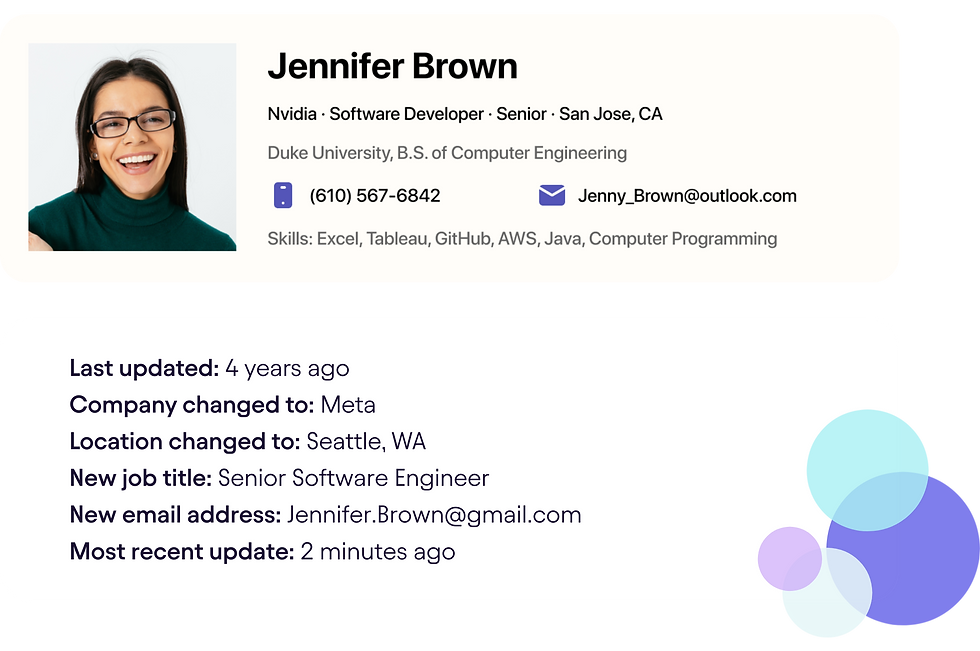
4. Lookup & Enrichment: Where Intelligence Becomes Actionable
Search helps you find candidates, but enrichment determines recruiters' ability to engage with the candidates.
This is where modern recruiting APIs separate themselves from traditional data providers.
What to Evaluate
Profile Completeness
Full employment history
Education details
Skills and competencies
Certifications and licenses
Social profiles
For specialized roles:
Technical: GitHub, Stack Overflow, programming languages
Healthcare: licenses, NPIs, certifications
Contact Data Quality
Personal emails
Verified emails
Mobile numbers
Strong coverage rates
Data Freshness
Best-in-class providers:
Continuously refresh data
Update candidate records frequently
Maintain high deliverability accuracy
Waterfall Enrichment
Modern APIs should intelligently aggregate data from multiple sources automatically to maximize enrichment success rates and profile completeness.
Performance
Fast response times are critical for:
AI recruiting agents
Real-time search experiences
Automated workflows
Embedded recruiting copilots

5. Compliance Matters More Than Ever
As AI recruiting scales, data compliance is not optional.
What to Look For
GDPR compliance
CCPA compliance
Responsible data sourcing practices
Respect for platform policies and restricted/private data
Why This Matters
Non-compliant sourcing practices can:
Create legal risk
Damage customer trust
Limit enterprise adoption
The best AI recruiting products are built on compliant, responsibly sourced data foundations.

6. Pricing That Scales With Your Product
Pricing should enable experimentation, iteration, and product growth.
What to Look For
Flexible credit-based pricing
Low-cost broad candidate search
Pay only when enrichment succeeds
Startup-friendly scaling
Enterprise-ready infrastructure
Why This Matters
AI recruiting platforms often iterate rapidly across:
Search experiences
Recommendation systems
AI workflows
Candidate engagement flows
Flexible pricing enables faster product innovation without large upfront commitments.
7. Ease of API Integration
If you’re building an AI recruiting product, integration speed matters.
What to Evaluate
Clean search and lookup endpoints
Structured, AI-ready response formats
Fast implementation timelines
Flexible workflows and integrations
Well-documented APIs
Typical Use Cases
AI recruiting agents
ATS platforms
CRM systems
Candidate matching engines
Talent intelligence platforms
Staffing software
Recruiting copilots
The best APIs act as a foundational recruiting intelligence layer for your product.
8. Support, Expertise & Product Partnership
The best APIs don’t just provide data — they help you build better recruiting products.
What to Look For
Deep expertise in recruiting technology
Understanding of recruiter workflows
Product-oriented collaboration
Fast support and iteration
Experience building recruiting systems at scale
Why This Matters
Building AI recruiting products requires understanding:
Search relevance
Matching logic
Recruiter UX
Candidate workflows
Data tradeoffs
Automation systems
Working with a provider that truly understands recruiting products can significantly accelerate your roadmap and improve recruiter experiences.
Final Thoughts
Choosing the right Candidate Sourcing API is no longer just a data decision — it’s an AI infrastructure decision.
The best APIs will:
Deliver intelligent AI-powered search
Understand recruiter intent and job descriptions
Recommend high-fit candidates automatically
Enable talent rediscovery workflows
Provide structured, enrichment-ready candidate data
Support AI agents and automation systems
Scale with your recruiting product growth
Modern recruiting products need more than Boolean search and raw profiles.
They need intelligent recruiting infrastructure.
Ready to Build Smarter AI Recruiting Products?
The DataVertex Candidate API helps recruiting platforms:
Power AI-driven candidate sourcing
Enable natural language and JD-based search
Match and recommend candidates automatically
Rediscover talent from ATS and CRM databases
Enrich candidate profiles with verified contact data
Launch faster with recruiting-focused infrastructure built by recruiting product experts
Book a meeting with our team to explore how DataVertex can power your AI recruiting platform.
